

Two complex and voluminous cases have had a significant impact on the Department of Criminal Cases work
20 January, 2026
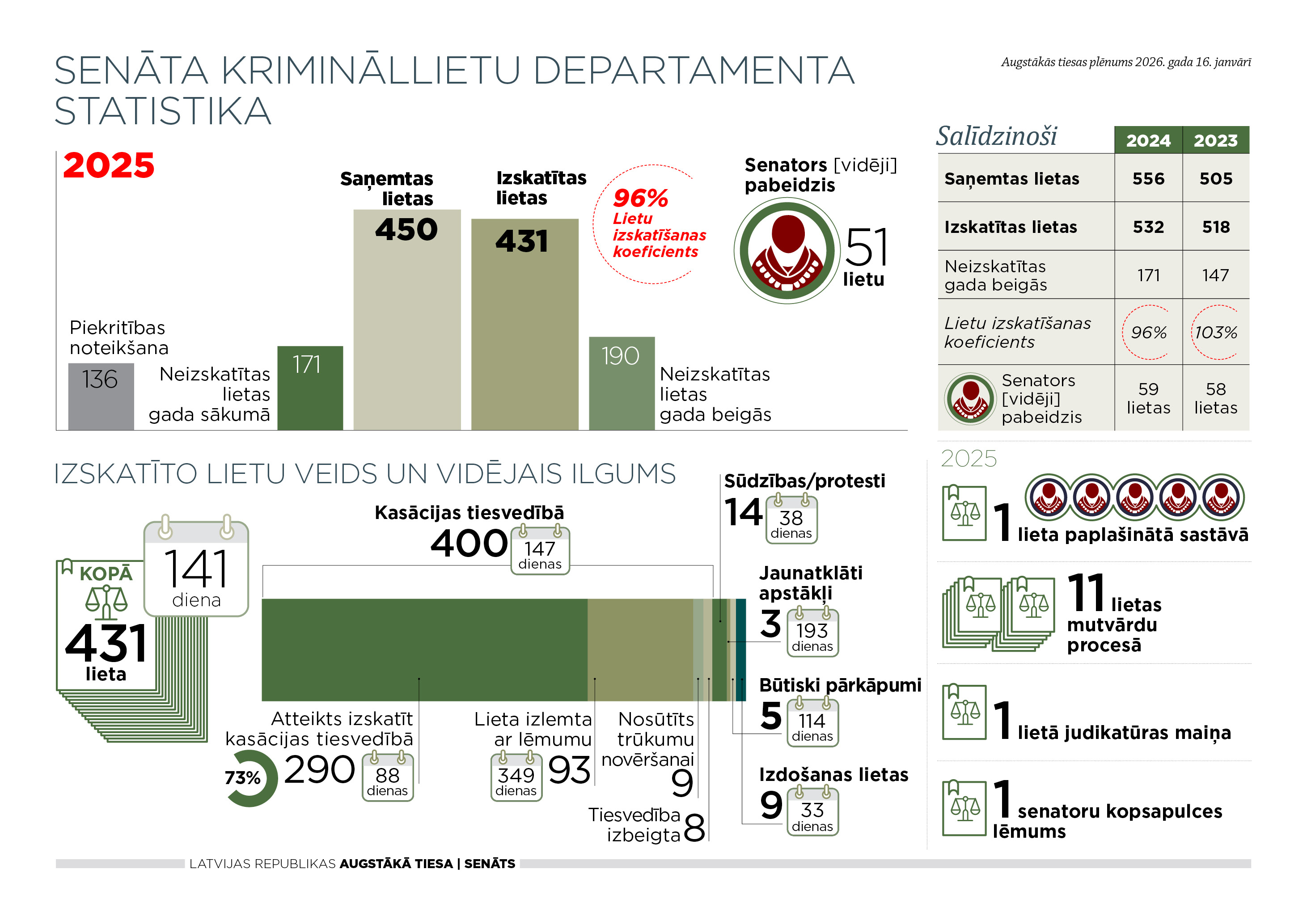
Last year, Aivars Uminskis was appointed as Chair of the Senate's Department of Criminal Cases, continuing the challenge of organizing the Department's work in such a way as to ensure faster case examination while maintaining the quality of work.
In 2025, the Department received 450 cases and examined 431 cases. The case examination rate is 96%, which means that the backlog of pending cases has increased slightly, by 19 cases. Out of the total number of pending cases, 11 cases were received in 2024.
The average time taken to examine a case is 4.7 months. In 2025, decisions on the initiation of cassation proceedings were taken in an average of 2.9 months, while cases were examined in cassation proceedings in an average of 11.6 months.
Looking back at the previous three years, the number of cases received and examined by the Department of Criminal Cases has decreased by about one-fifth. In his report, the Chair of the Department addressed the challenges of the previous year that affected the work results.
Firstly, there was a change of senators – two long-standing senators left their posts, and it took some time to fill the vacancies, therefore the Department worked in an incomplete composition for a considerably long period of time.
Furthermore, the ability to ensure faster case examination was affected by the complex and voluminous cases pending before the Department, the review of which required significant departmental resources, which in turn affected the time required to examine other cases and the workload of senators. For example, the case of Lembergs and other defendants has 349 volumes, each consisting of 250 pages, the first instance court judgment has 1924 pages, and the appeal court judgment has 579 pages. The case includes a prosecutor's protest and 15 cassation complaints, totalling 1021 pages. One of the so-called digital television cases is also continuing, comprising 41 volumes, nine defendants, a cassation protest with additions submitted in the case, totalling 71 pages, and the appellate court's ruling, totalling 222 pages. In addition, this case involves a complex legal issue that has not been previously addressed in the judicial practice, namely whether actions of a person who achieved the adoption of a favourable regulatory act in order to be able to select a specific commercial entity as a service provider in the selection process of tenderers constitute a fraudulent act.
What regards the case-law of 2025, the Chair noted Department's involvement in the creation of three case-law compilations. When discussing one of these compilations (violations of road traffic rules and vehicle operation rules) the Department's general meeting of senators adopted a decision providing an explanation of the causal link in a situation where consequences were caused by two or more vehicle drivers, and whether the violation committed by the accused, which is causally related to the consequences, was impacted by the victim's actions in the traffic accident.
The Chair also mentioned several decisions of the Department in which the Senate expressed significant findings, such as regarding the moment of completion of theft, the assessment of a partial entry as evidence, the handling of funds in the bank account of a deceased person, the imposition of coercive measures on a legal person.
Aivars Uminskis pointed out that the case-law developed by the Department and the dialogue with lower courts have contributed to the quality of court rulings. This is evidenced by statistics on the Department's refusals to initiate cassation proceedings and overturned or amended decisions of lower courts – in 2025, cassation proceedings were initiated in only one in four cases, and in three-quarters of those cases, the decisions of lower courts were overturned or amended.
The Chair also pointed out that the decrease in the number of cases received is also related to the Department's work in previous years, which has been essential for strengthening the case-law, and the subsequent amendments to the Criminal Procedure Law by which it was reinforced that decisions of courts of appeal are final in cases that are examined without the assessment of evidence.
What regards the objectives for 2026, the Chair of the Department spoke about the planned case-law compilations, taking into account the topicality of relevant issues. It is planned to prepare compilations on determining the value of destroyed or damaged property, on the grounds for decisions to conduct searches, and on the court's right to recognize as proven the actual circumstances or legal qualification of a criminal offense that differ from the charges. In addition, the case-law compilation on cases concerning illegal crossing of the state border, which was started last year, is to be completed.
In order to facilitate faster completion of criminal proceedings, the Department has undertaken to raise the issue of necessary amendments to the Criminal Procedure Law, which would allow the court of cassation, when overturning a decision of a court of appeal, to decide to leave a decision of a court of first instance unchanged.
- Aivars Uminskis' report on the work of the Senate’s Department of Criminal Cases in 2025 will be published in the next issue of the Supreme Court Bulletin.
Information prepared by
Rasma Zvejniece, Head of the Division of Communication of the Supreme Court
E-mail: rasma.zvejniece@at.gov.lv, telephone: +371 67020396, +371 28652211