

Supreme Court senators broaden their understanding of the work of the European Court of Human Rights
8 December, 2025
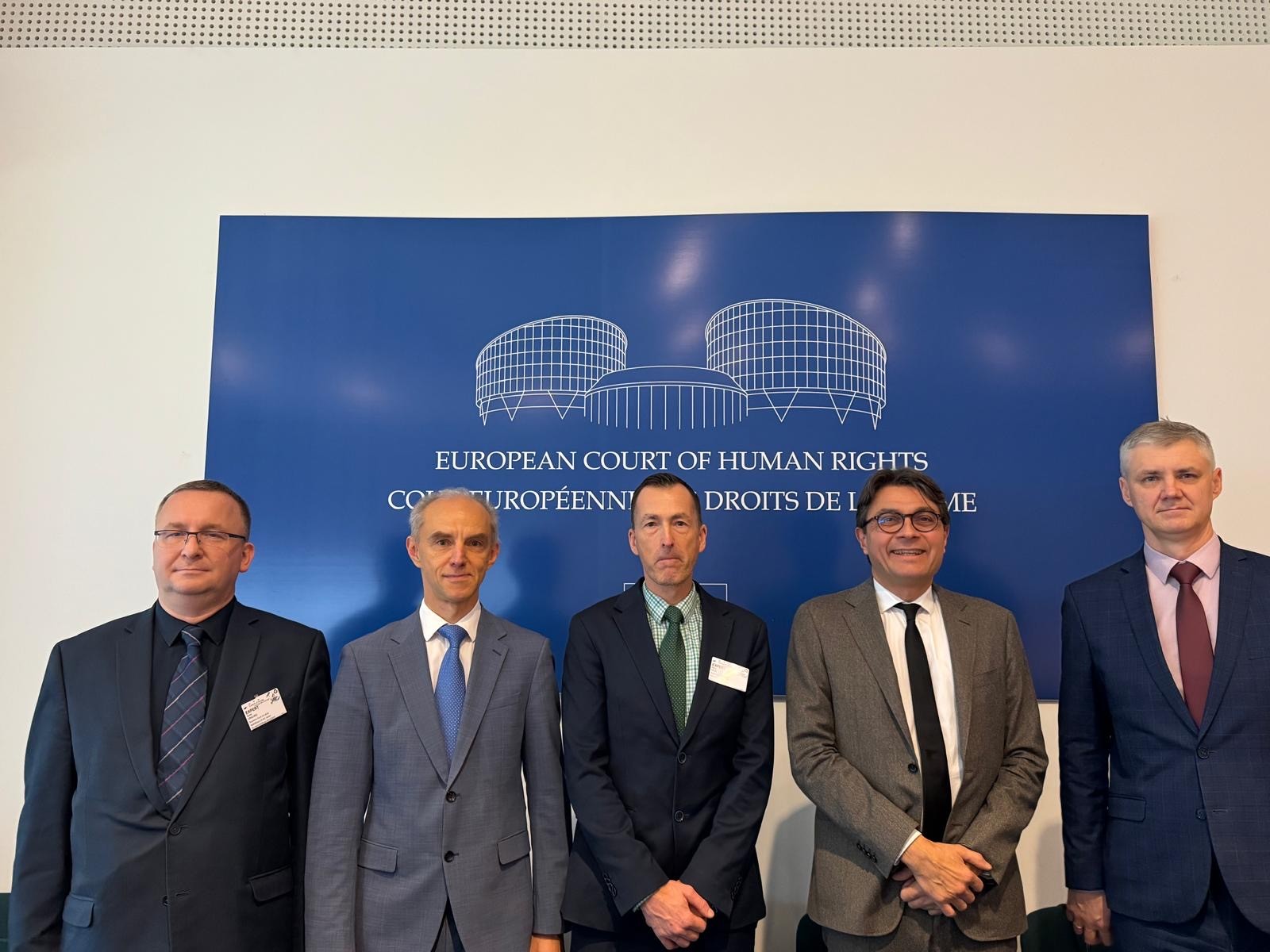
From the left: Senator Gvido Ungurs, ECtHR Judge Artūrs Kučs, Senator Māris Leja, ECtHR President Mattias Guyomar, Senator Ermīns Darapoļskis
Last week, a delegation of Supreme Court senators visited the European Court of Human Rights (ECtHR) for an experience-sharing visit. The delegation included Gvido Ungurs, Senator of the Department of Civil Cases, Māris Leja, Senator of the Department of Criminal Cases, and Ermīns Darapoļskis, Senator of the Department of Administrative Cases.
The senators met with the President of the European Court of Human Rights, Mattias Guyomar. During the meeting, the necessity for cooperation and direct contact between national courts and the ECtHR thus strengthening mutual ties and dialogue was emphasized.
During the visit, the senators learned about the work of the European Court of Human Rights – the structure and jurisdiction of the Court, the procedure for initiating proceedings and examining cases, the process of adopting judgments, and current case law developments.
In a discussion with ECtHR judge Artūrs Kučs, current developments in ECtHR case law were examined and the ECtHR's decision-making procedure was discussed: the examination of cases in committees, chambers and the Grand Chamber, the admissibility assessment, and the preparation and adoption of judgments.
During a meeting with senior legal adviser Lāsma Liede, attention was focused on the latest developments in ECtHR case law. The discussion covered the ECtHR judgment in the case of Helme v. Estonia and the ECtHR Committee's decision in the case of Pīlāgs v. Latvia. Both cases relate to the issue of provocation by investigative authorities.
The senators listened to several presentations by lawyers of the Court's Registry on the ECtHR's findings in cases against Latvia relating to the right to have a case examined within a reasonable time; the ECtHR's findings on the presumption of innocence in rulings related to statements made by public officials; the ECtHR's latest case law on immigration issues; the reasoning behind rulings and the court's obligation to respond to arguments relevant to the case within the context of the right to a fair trial.
During the visit to the ECtHR's Central Office and Archives, the senators learned about the ECtHR's procedures for processing incoming documents.
Whereas, in a meeting with a representative of the ECtHR's Department for the Execution of Judgments, the senators learned about the work of the Department and its role in monitoring the execution of judgments, the main stages of judgment enforcement and cooperation with member states, as well as the most common challenges in enforcing judgments at the national level.
The senators acknowledge that analyzing judgments solely on the basis of their text available does not always allow for a full understanding of the proceedings, and therefore it is particularly useful to familiarize oneself with the work of the ECtHR on site. Direct insight into the process provides a detailed overview of how judgments are formed and how argumentation is constructed. This broadens the understanding of procedural nuances and the role of national courts in the Convention system. An important newly explored aspect is the insight into the mechanisms for monitoring the enforcement of judgments and the practical problems involved, which allows for a better assessment of the significance of ECtHR case law at the national level.
Division of Communication of the Supreme Court
T. +371 67020396, +371 28652211; komunikacija@at.gov.lv